
This year’s winter build competition is the Indoor Scrap-box Glider Challenge .
The idea of the challenge is to build a small chuck/catapult glider, using materials that you have in your scrap-box or recycling bin (ie not specifically purchased), and fly it (or them) in an indoor competition for the usual comestible prizes. The event will comprise what has come to be our usual winter indoor flying challenge format. Clearly, the main objective is to have fun, but it’s also an opportunity for those who haven’t attempted to design and/or build a simple model to give it a try.
The flying part of the challenge will take part on Wednesday 18th February 2026 at Begbroke Village Hall. The intention is to hold a light-hearted indoor flying competition which is easy to take part in, and to challenge experienced flyers while giving beginners a good chance of success. The rules are simple, and the models easy and inexpensive to build – indeed, ideally, they should cost virtually nothing!
You have from now until 18th February Begbroke meeting to build your Scrapbox Challenge Glider, it can be from one of the plans you can download below or to your own design. Let you imagination run riot


The range of different ideas was impressive too from a wonderful scale primary glider by David Fillingham to my simplistic foam chuck glider . Bob Lee had a wonderful looking Skyray from the Bill Dean plan and Duncan Martin sported a nice profile Lightning. Andy Stephenson also went down the delta jet glider route. Canards proved popular with both Gary Law and Brian Harvey making balsa gliders which performed well. Colin Sharman’s canard needed some running repairs but he had also brought along the smallest model of the meeting a tiny 4” span chuck glider in balsa. Mike Beach had a very unusual choice for wings as they made from aluminium drinks cans , tonic water in fact, they worked very well making distinctive sound on landing . Foam was also a popular choice with Andy Crisp producing a simple design which flew very slowly along with myself and several others
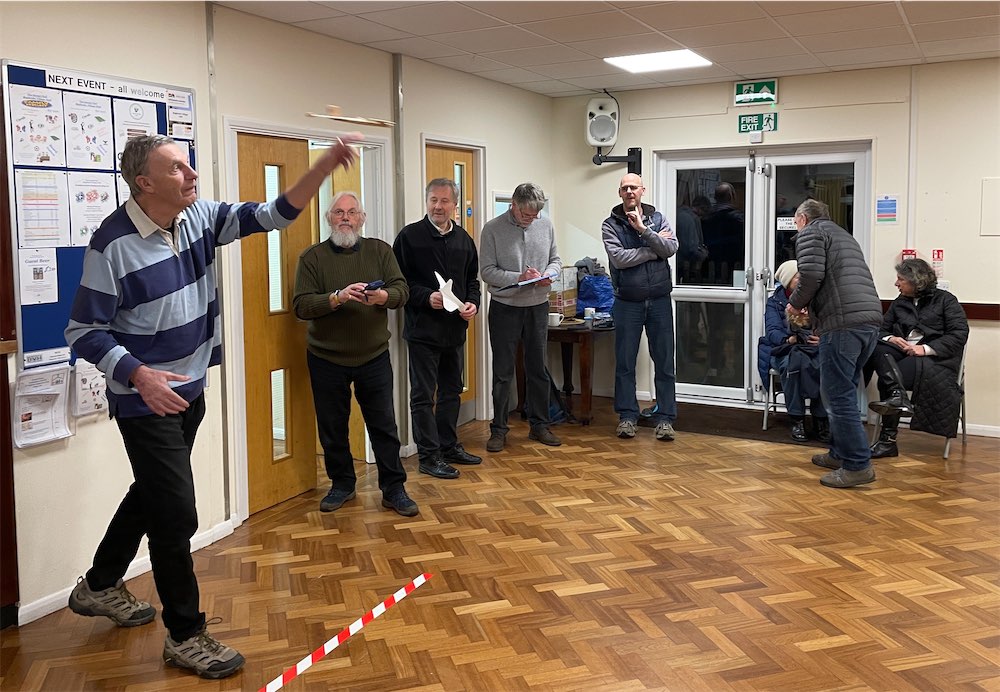
The flying part consisted of 3 parts- a duration event, a fly through the hoop and a spot landing competition. Simon Burch the instigator of the event was CD with Roger Matthews taking on timing duties armed with his phone and the knowledge that his decision is final. The evening started with some general trimming for people to try the gliders in the hall , most had only previous made flights across the bed so good fun was had trying them out
he first event was the duration, each flyer is given 3 flights the total giving the final score the key seemed to be having a very slow flying model to make use of the small size of the hall . Both myself and Andy Crisp went down this route using wall foam and simple chuckie design. The lightweight and resultant floaty glide paid off with both managing a 5 second flights, in the end I hit the walls less times than Andy and came first with Gary Law in third with his canard glider.
2026 Results
Event 1 – Duration
| Name | Flight 1 | Flight 2 | Flight 3 | Total | Pos |
| Chris Brainwood | 5.85 | 4.91 | 4.38 | 15.14 | 1 |
| Andy Crisp | 5.04 | 5.17 | 3.73 | 13.94 | 2 |
| Gary Law | 3.92 | 4.10 | 3.71 | 10.73 | 3 |
| David Fillingham | 2.77 | 3.87 | 3.61 | 10.25 | 4 |
| Brian Harvey | 3.16 | 3.08 | 2.75 | 8.99 | 5 |
| Andy Stephenson | 2.82 | 3.02 | 2.82 | 8.66 | 6 |
| Alan Trinder | 2.49 | 2.30 | 2.39 | 7.18 | 7 |
| Mike Beach | 2.50 | 2.36 | 2.12 | 6.98 | 8 |
| Martin Bennett | 2.90 | 2.68 | 1.02 | 6.60 | 9 |
| Duncan Martin | 2.04 | 2.10 | 1.82 | 5.96 | 10 |
| Bob Lee | 1.21 | 1.90 | 1.47 | 4.58 | 11 |
| Colin Sharman | 1.04 | 0.88 | 0.78 | 2.70 | 12 |
For the ‘Fly Through the Hoop’ a Hula Hoop was suspended from the ceiling some 3m or so in front launch point. Again a period of trimming before hand allowed everyone to have a couple of goes and it proved much harder than it looks. My own floaty glider would not float through the hoop it always floated past it so there was no alternative …more nose weight .With the nose weight tripled the model could now be given more of direction if with somewhat steeper glide. A few others took this route but some gliders were just better suited and/or better launched to get through the hoop. A duration score was added if the model made it through to decide the winner . Brian Harvey came out on top followed by Mike Beach and his Tonic water can winged creation, I was third with my nose weight attached to a model . Duncan Martin proved just how tricky it can be wedging his foam Lightning between the ceiling and the hoop much to everyone’s and his own amusement
EVENT 2 – Through the Hoop
| Name | Flight 1 | Flight 2 | Flight 3 | Total | Pos |
| Brian Harvey | 2.22 | 2.82 | 1.64 | 6.68 | 1 |
| Mike Beach | x | 3.03 | 2.83 | 5.86 | 2 |
| Chris Brainwood | 2.32 | x | 2.70 | 4.49 | 3 |
| Colin Sharman | x | 2.14 | 2.17 | 4.31 | 4 |
| Andy Stephenson | x | 2.12 | 1.91 | 4.03 | 5 |
| Alan Trinder | 1.34 | 2.27 | x | 3.61 | 6 |
| David Fillingham | x | 3.45 | x | 3.45 | 7 |
| Martin Bennett | 1.54 | x | 1.44 | 2.98 | 8 |
| Duncan Martin | 1.24 | x | 1.54 | 2.78 | 9 |
| Gary Law | 2.38 | x | x | 2.38 | 10 |
| Andy Crisp | x | x | x | ||
| Bob Lee | x | x | x |
The final event was the spot landing. A paper sheet had been marked up with some scoring zones from 1 to 4 with a cardboard box at one end to provide something to aim for to get the elusive score of 5 .
Only Duncan Martin and Alan Trinder managed to hit the jackpot 5 but Duncan’s 4 on flight 3 sealed his win. Two 4’s from Colin Sharman saw him take second while my noseweight was still doing it’s job for third.
Event 3 – Spot Landing
| Name | Flight 1 | Flight 2 | Flight 3 | Total | Pos |
| Duncan Martin | 5 | x | 4 | 9 | 1 |
| Colin Sharman | 4 | 4 | x | 8 | 2 |
| Chris Brainwood | 1 | 2 | 3 | 6 | 3 |
| Alan Trinder | 5 | x | x | 5 | 4 |
| Mike Beach | 4 | x | x | 4 | 5 |
| Bob Lee | x | 3 | x | 3 | 6 |
| David Fillingham | 1 | x | 1 | 2 | =7 |
| Martin Bennett | 2 | x | x | 2 | =7 |
| Andy Crisp | 1 | x | 1 | 2 | =7 |
| Andy Stephenson | x | 1 | x | 1 | 10 |
| Brian Harvey | x | x | x | ||
| Gary Law | x | x | x |
There were other prizes on offer too. David Fillingham won ‘Special Model’ with his wonderful primary gliderMartin Bennett won ‘Best Scrapbox Model’ with his balsa gliderBob Lee won ‘Wooden Spoon’ with his SkyrayIt was a fun evening with chocolate based prizes and even an RTF model for those lucky enough to win. Many thanks to Simon Burch and Roger Matthews for coming up with the idea and running the competition so smoothly on the night
The rules are simple:
Proposed Challenges:
Flying:
1. Duration – longest total flight time wins (3 flights total)
2. ‘Fly Through the Hoop (30″ diameter hole)’ – 3 timed flights permitted. Launch from behind a start line. 15 seconds added for each time the model passes through the hoop.
3. ‘Spot Landing’ – land on a ‘runway’ with pre-marked scores. Launch from behind a start line 3 attempts: total score counts.
Non-flying:
1. Best looking model (in the judges’ opinion)
2. Most innovative model
Other prizes might be awarded at the Chair’s discretion.
All club members are most welcome to attend. If you have any questions about this please don’t hesitate to contact me at:

Bob Lee’s Bill Deans F4D Skyray. Built from foam(Depron & Vectorboard) it weights 10 grams and with its huge wing area it floats across the bedroom.


Here’s a few plans you can download to get your imagination started
Each opens as a PDF


Enjoy your building and see you at Begbroke on February 18th 2026
